🔎 PROACTIVELY REVIEW YOUR TAX IDENTIFICATION NUMBER TO PROTECT YOUR RIGHTS AND RESOLVE BUSINESS OBSTACLES
The Tax Department requests that enterprises, household businesses and individuals to proactively check the status of their tax identification numbers, complete any outstanding obligations, and promptly detect cases where personal information may have been used unlawfully to register a business.
Early review not only helps reduce late payment interest, penalties and legal risks, but also contributes to building a more transparent and secure business environment.
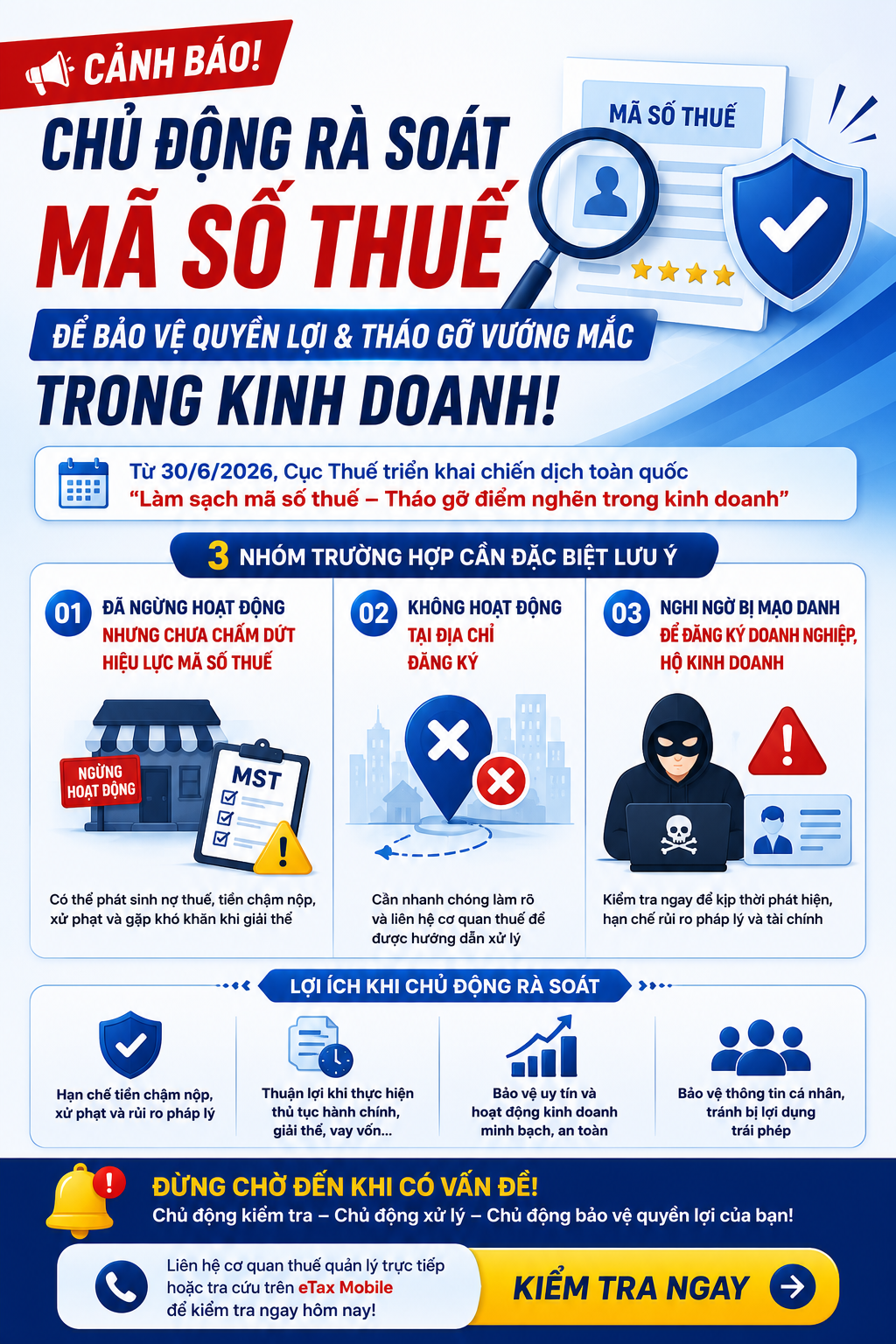
On 30 June 2026, The Tax Department issued an open letter requesting taxpayers to proactively review their tax identification numbers to protect their legitimate rights and interests, and to resolve any issues relating to benterprises and household businesses that have ceased operations or are no longer operating at their registered addresses.
This is an important part of the nationwide campaign:
“Cleaning up tax identification numbers – Removing business bottlenecks”
implemented by the tax sector nationwide.
📌 1. Why should enterprises proactively check the status of their tax identification numbers?
In the course of maintaining production and business operations, enterprises and household businesses must fulfil various obligations relating to:
- 🏢 Business registration;
- 🧾 Tax filing;
- 💰 Tax payment;
- 📄 Invoice usage;
- 🔄 Updating information with regulatory authorities.
When they no longer need to continue business operations, some entities may cease operations in practice but have not yet completed the procedures for terminating the validity of their tax identification numbers or completing dissolution procedures.
In other cases, the business may no longer operate at its registered address, but the legal representative has not yet contacted the tax authority to handle outstanding dossiers or procedures.
This situation may lead to consequences such as:
- ⚠️ Missing tax returns continuing to accumulate over multiple periods;
- ⚠️ Increased tax obligations, late payment interest or administrative penalties;
- ⚠️ Enterprises or household businesses being recorded as not operating at their registered addresses;
- ⚠️ Prolonged dissolution or business termination procedures;
- ⚠️ Legal representatives, enterprise owners or household business owners facing difficulties when carrying out other procedures;
- ⚠️ Risks relating to invoices, financial obligations and legal responsibilities.
✅ Therefore, even if they have ceased business operations in practice, enterprises and household businesses still need to complete all required procedures with the tax authority and business registration authority.
🚨 2. Warning: Unauthorized use of personal information for business registration
In addition to cases where businesses have ceased operations but have not yet completed the required procedures, the tax authority has also recorded cases where certain organisations and individuals take advantage of the establishment of enterprises or household businesses to carry out acts such as:
- 🚫 Illegal trading of invoices;
- 🚫 Fraud;
- 🚫 Seeking unlawful gains from the State budget.
Notably, there have been cases where citizen identification information and personal information have been forged or used unlawfully to establish enterprises or household businesses.
Individuals may be registered as:
- Enterprise owners;
- Household business owners;
- Legal representatives;
even though they are completely unaware of the matter, have not contributed capital and are not directly involved in management.
If not detected and handled promptly, the impersonated individuals may face various difficulties and may even have to complete procedures to prove that they are not involved in the activities of the unlawfully registered enterprise or household business.
🔐 The tax authority recommends that individuals:
- ✅ Do not lend, lease or allow others to use your citizen identification card or personal information;
- ✅ Do not buy, sell or hand over personal identification information to others for enterprise or household business registration;
- ✅ Do not sign documents without fully understanding their contents and intended purpose;
- ✅ Proactively check business registration information to promptly detect any irregularities;
- ✅ Protect images of your citizen identification card, personal identification number, electronic accounts and other personal authentication data.
📱 In the coming period, the tax authority is expected to launch a lookup function on the eTax Mobile application, helping individuals conveniently monitor information and detect signs of impersonation for the purpose of establishing enterprises or household businesses.
🧹 3. The tax sector launches a nationwide campaign to clean up tax identification number data
The campaign “Cleaning up tax identification numbers – Removing business bottlenecks” aims to standardise data, accurately determine taxpayers’ operational status and resolve outstanding dossiers.
Accordingly, tax authorities at all levels will carry out the following tasks:
- 🔎 Review and standardise tax identification number data;
- 🔄 Reconcile registration status with actual operations;
- 📁 Classify dossiers requiring support for resolution;
- ✅ Identify cases requiring reactivation of tax identification numbers;
- 📌 Provide guidance on terminating the validity of tax identification numbers for entities that are no longer operating;
- ⚖️ Coordinate with competent authorities to address risks relating to tax, invoices and legal status;
- 🚫 Detect and prevent the misuse of enterprises, household businesses and e-invoices for unlawful purposes.
For the review process to be effective, taxpayer cooperation plays a particularly important role.
Tax authorities can only resolve cases thoroughly when taxpayers provide complete documentation, explain relevant information and clearly determine whether they need to:
- Continue operations; or
- Terminate business operations.
⚠️ 4. Three key groups requiring special attention
4.1. Operations have ceased but the validity of the tax identification number has not been terminated
Enterprises or household businesses that have ceased operations in practice should proactively contact the directly managing tax authority for review and guidance on the next steps.
Tasks that may need to be completed include:
- 📄 Supplementing missing tax return dossiers;
- 📁 Providing documents or explanations upon request;
- 💰 Completing outstanding tax payments, late payment interest and other outstanding financial obligations;
- 🧾 Handling unused invoices or invoice-related issues;
- ✅ Completing procedures for terminating the validity of the tax identification number.
After fulfilling their obligations with the tax authority, the enterprise or household business should continue the procedures with the business registration authority to complete dissolution or business termination in accordance with regulations.
4.2. Not operating at the registered address
Where an enterprise or household business is determined not to be operating at its registered address, the enterprise owner, household business owner or legal representative should promptly clarify the appropriate course of action.
If business operations are to continue
The taxpayer should contact the tax authority for guidance on:
- Reactivating the tax identification number;
- Update information;
- Carrying out address change procedures in accordance with regulations.
If business operations will not continue
The taxpayer should carry out dissolution or business termination procedures and, at the same time:
- 📄 Complete any missing tax return dossiers;
- 💰 Settle tax and invoice-related obligations;
- ⚖️ Comply with any administrative penalty decisions, if applicable;
- ✅ Complete procedures for terminating the validity of the tax identification number;
- 🏢 Carry out the corresponding procedures with the business registration authority.
⚠️ Allowing the “not operating at the registered address” status to remain unresolved for an extended period may increase compliance costs and make it more difficult for the enterprise to resume operations or complete dissolution procedures.
4.3. Unauthorized use of personal information is detected
When individuals discover that they have been named as the owner of an enterprise, the owner of a household business or the legal representative without their knowledge or involvement, they should promptly:
- 📌 Retain search results and documents showing the irregular information;
- 🏢 Notify the business registration authority;
- 👮 Report the matter to the police;
- 🧾 Contact the tax authority managing that enterprise or household business;
- 📁 Cooperate in providing documents so that the competent authority can verify and handle the matter.
⚠️ Individuals should not directly negotiate with organisations or individuals suspected of unlawfully using their personal information if doing so may result in the loss of documents or evidence, or make the matter more complicated.
⏳ 5. Delayed cooperation may increase tax obligations and legal risks
The Tax Department recommends that taxpayers promptly contact their directly managing tax authority upon receiving a notice or invitation to work with the tax authority.
Delays may cause the status of having ceased operations without completing the required procedures, or not operating at the registered address, to remain unresolved for a longer period.
As a result, taxpayers may face:
- ⚠️ Continuing tax obligations;
- ⚠️ Late payment interest;
- ⚠️ Administrative penalties;
- ⚠️ Tax debt enforcement measures;
- ⚠️ Public disclosure of information in accordance with regulations;
- ⚠️ Increased costs for dossier processing and error correction;
- ⚠️ Legal risks relating to the enterprise, invoices and obligations of the legal representative.
✅ Therefore, early action is often an effective way to save time and costs, while limiting legal consequences.
🤝 6. The tax authority supports cases where taxpayers voluntarily remedy errors
The tax authority is committed to facilitating taxpayers who cooperate and voluntarily remedy errors caused by objective factors.
Conversely, for taxpayers who have been notified or invited to work with the tax authority but fail to cooperate, the tax authority may apply tax administration measures appropriate to the nature and severity of the violation.
Where there are signs of misuse of legal entities or e-invoices for unlawful purposes, the tax authority will coordinate with competent authorities to verify, investigate and handle the matter.
Measures may include:
- Public disclosure of information;
- Tax debt enforcement;
- Transfer of dossiers to competent authorities in accordance with regulations.
✅ 7. What should taxpayers do right now?
Enterprises, household businesses and individuals can proactively take the following steps:
Step 1: Look up information
Check the operational status, tax identification number, registered address, legal representative and other relevant information through official lookup channels.
Step 2: Compare with the actual situation
Determine whether the enterprise or household business is:
- Operating normally;
- Temporarily suspended;
- Has ceased operations but has not yet completed the required procedures;
- Currently recorded as not operating at its registered address.
Step 3: Check for outstanding obligations
Review:
- Tax return dossiers;
- Invoices;
- Outstanding tax payable;
- Late payment interest;
- Penalty decisions, if any.
Step 4: Determine the appropriate course of action
Choose the suitable option:
- Continue operations;
- Reactivate the tax identification number;
- Change registration information;
- Terminate operations.
Step 5: Contact the directly managing tax authority
Prepare the necessary documents and work with the responsible division to receive guidance based on the specific status of the taxpayer.
Step 6: Complete the relevant procedures
After fulfilling tax obligations, continue with the procedures for dissolution, business termination or registration updates with the competent authority.
🛡️ 8. Proactive review helps protect your own interests
Checking tax identification numbers is not only a requirement of state administration, but also a practical measure for each enterprise, household business and individual to protect their legitimate rights and interests.
Timely cooperation with the tax authority will help:
- ✅ Resolve outstanding dossiers;
- ✅ Limit additional financial obligations;
- ✅ Minimise legal risks;
- ✅ Clean up tax identification number data;
- ✅ Prevent the misuse of legal entities and e-invoices;
- ✅ Contribute to a safe, transparent and healthy business environment.
📌 Note
The above content is intended for general information purposes only. Documentation, obligations and handling procedures may vary depending on each specific case. Taxpayers should contact their directly managing tax authority or a professional adviser for appropriate guidance.
📲 Follow MBA’s Fanpage and read the detailed articles on our website for more useful updates on accounting, auditing and tax.
- 🚨 OFFICIAL LETTER 5487/CT-CS (25/11/2025): LATE PAYMENT STILL ELIGIBLE FOR VAT CREDIT – IF PAID BY NON-CASH METHOD!
- NEW REGULATIONS ON ACCOUNTING, TAXES, AND SOCIAL INSURANCE EFFECTIVE FROM JANUARY 1, 2026
- 👉 VAT REFUND CONDITIONS FOR EXPORTS – DON’T GET IT WRONG!
- 🚨 FROM 1 JULY 2026: OUTSTANDING TAX LIABILITIES MAY RESTRICT EXIT FROM VIETNAM
- Circular 99/2025/TT-BTC – The End of the Accounting Era Where “All burdens fall on one person”