🛒 TAX AND E-INVOICES FOR ONLINE BUSINESS ACTIVITIES:
KEY POINTS TO NOTE FROM 1 JULY 2026
According to the Tax Department’s guidance materials on “New tax policies and e-invoices in e-commerce and multi-channel
sales”, from 1 July 2026, online sellers and businesses should pay particular attention to the new regulations on tax, revenue
and e-invoices.
These regulations apply to various groups operating in the digital business environment, including:
- 🏢 Enterprises;
- 🧾 Household businesses;
- 👤 Individuals selling online;
- 🛍️ Sellers on e-commerce platforms;
- 🎥 KOLs/KOCs and streamers;
- 🔗 Affiliate marketers;
- 💻 Freelancers and content creators;
- 🌐 Related digital platforms.
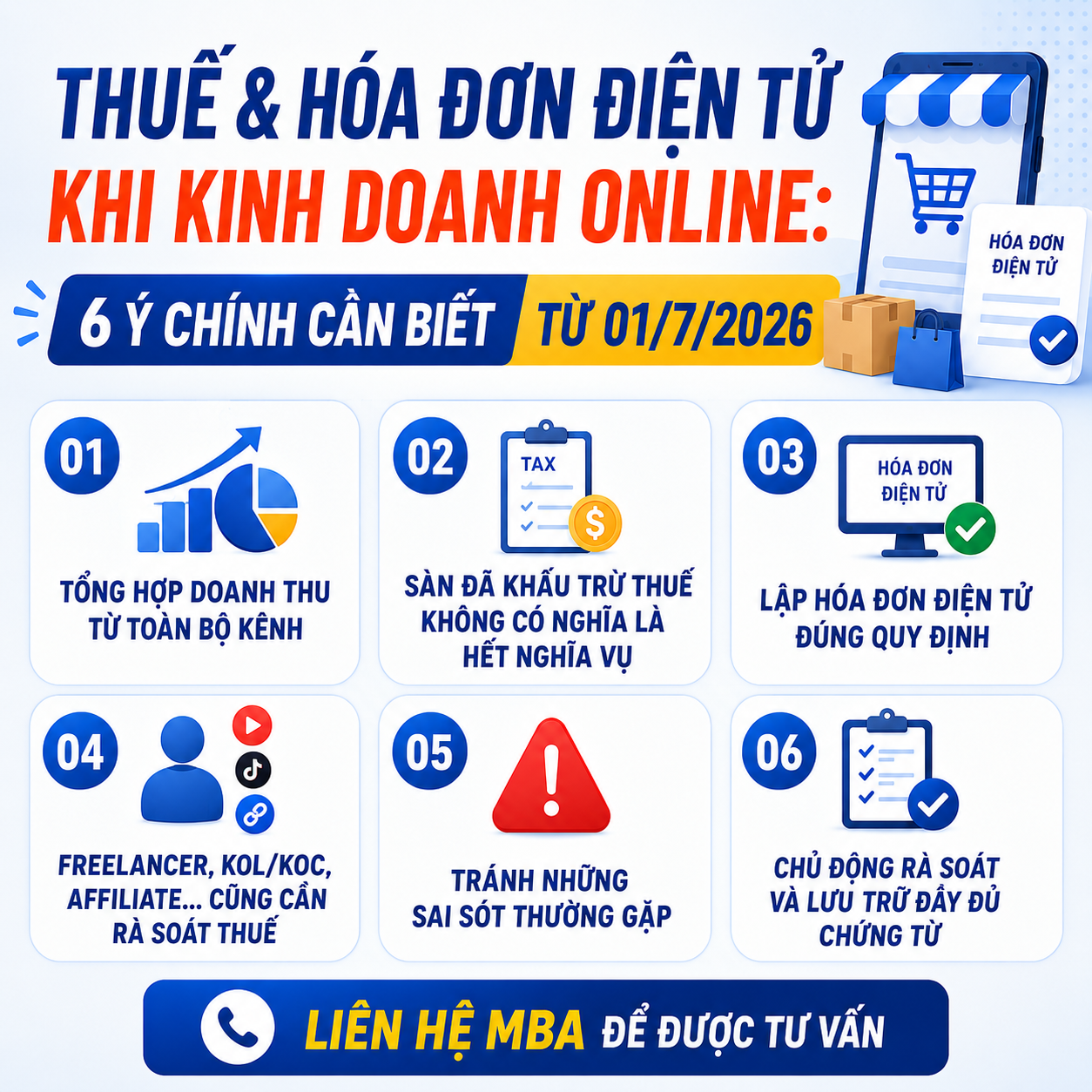
📌 1. Multi-channel sellers must still consolidate all revenue
Many sellers and business operators today sell through multiple channels at the same time, such as:
- Shopee, TikTok Shop, Lazada;
- Facebook, Zalo, livestream;
- Their own websites;
- Delivery apps such as Grab and Be;
- Physical stores.
Taxable revenue is not limited to revenue from a single platform or one payment receiving account. It must be aggregated
from all sales channels.
💡 Simple example
If a household business sells on Shopee, sells through Facebook and also operates a physical store, it needs to track the
total revenue from all these channels to correctly determine its tax obligations.
📌 2. Tax withheld by an e-commerce platform does not mean
the seller has fully completed all tax obligations
In some cases, e-commerce platforms or digital platforms are responsible for withholding, declaring and paying tax
on behalf of sellers.
However, seller still needs to:
- ✅ Track the amount of tax already withheld;
- ✅ Reconcile it with actual revenue;
- ✅ Determine whether additional tax declaration, payment or finalization is required;
- ✅ Retain documents, bank statements and transaction data.
⚠️ Important note
Tax withheld by a platform does not mean that the seller is exempt from all tax obligations.
Sellers still need to monitor their revenue, supporting documents and tax withheld to ensure the data accurately
reflects their actual business activities.
📌 3. When must e-invoices be issued?
Sellers of goods and service providers must issue e-invoices in accordance with regulations when goods are sold or
services are provided.
For online sales, the timing of invoice issuance is usually linked to:
- Transfer of ownership of goods;
- Transfer of the right to use goods;
- Completion of service provision.
Sellers should note:
- ✅ Issue invoices with accurate information on the buyer, goods, services, value and timing;
- ✅ Do not combine multiple transactions into one invoice unless permitted by law;
- ✅ Synchronise data between orders, payments, delivery and invoices;
- ✅ Adjust invoices when order cancellations, exchanges, returns or refunds arise;
- ✅ Retain complete invoices and data linked to the original transaction.
📌 4. Freelancers, KOLs/KOCs and affiliate marketers should
also review their tax obligations
Individuals earning income from digital platforms should also pay attention, including those who:
- 🎥 Create YouTube and TikTok videos;
- 🔗 Earn affiliate commissions;
- 📣 Act as KOL/KOC to promote products;
- 🧑🏫 Teach online;
- 💻 Provide freelance services.
Depending on the nature of the activity, the income may be classified as:
- Business income; or
- Employment income.
This classification directly affects:
- Tax calculation;
- Tax declaration method;
- Documents to be prepared;
- Obligations to provide supporting evidence during tax inspection or tax audit.
📌 5. Common mistakes in online and multi-channel sales
Business operators often make the following mistakes:
- ⚠️ Only tracking revenue from one platform and overlooking revenue from other channels;
- ⚠️ Assuming that no further review is needed once the platform has withheld tax
- ⚠️ Using multiple payment receiving accounts without consolidating all revenue data;
- ⚠️ Issuing invoices at the wrong time;
- ⚠️ Failing to handle invoices when refunds, order cancellations or returns arise;
- ⚠️ Failing to retain complete contracts, bank statements, payment documents and order data;
- ⚠️ Confusing actual cash received with taxable revenue.
These mistakes may lead to:
- Revenue discrepancies;
- Tax under-declaration;
- Invoices being issued not in accordance with regulations;
- Difficulties in providing explanations during tax inspection or tax audit.
📌 6. What should business operators do to comply?
To mitigate risks, individuals and household businesses should take the following steps:
- ✅ Correctly identify whether they are an individual business operator, a household business or an enterprise;
- ✅ List all sales channels currently in use;
- ✅ Consolidate revenue from all platforms, social media channels, websites, physical stores and payment receiving
accounts; - ✅ Reconcile the amount of tax already withheld and paid on their behalf by platforms;
- ✅ Check whether e-invoices are mandatory in their case;
- ✅ Issue and retain invoices, supporting documents, bank statements and order data;
- ✅ Conduct monthly or quarterly reviews to detect errors early.
💡 PRACTICAL PERSPECTIVE
Online business, sales on e-commerce platforms and multi-channel sales do not change the nature of tax obligations.
Business operators still need to properly manage:
- 💰 Revenue;
- 🧾 Invoices;
- 📄 Supporting documents;
- 🏦 Bank statements;
- 📦 Order data;
- 📌 Tax already withheld and paid on their behalf.
The practical challenge is that revenue may arise from multiple sources, including e-commerce platforms, social media
channels, websites, e-wallets, bank accounts, cash payments and intermediary platforms.
Without a consolidated tracking sheet, business operators may easily miss revenue or confuse actual cash received with
taxable revenue.
✅ WHAT SHOULD ENTERPRISES AND HOUSEHOLD BUSINESSES DO?
To be better prepared from 1 July 2026, online sellers and business operators should proactively take the following actions:
1️⃣ Review the business model
Identify the form under which they are operating:
- Individual business operator;
- Household business;
- Enterprise;
- Freelancer;
- KOL/KOC;
- Affiliate marketer;
- Content creator.
2️⃣ Consolidate all revenue sources
Do not track only one sales channel. Revenue should be consolidated from:
- E-commerce platforms;
- Social media channels;
- Websites;
- Livestreaming;
- Physical stores;
- Delivery apps;
- Payment receiving accounts;
- E-wallets or intermediary platforms.
3️⃣ Check e-invoicing obligations
Sellers should determine:
- When invoices must be issued;
- Which type of invoice should be issued;
- The timing of invoice issuance;
- How to handle order cancellations, returns and refunds;
- How to retain invoice and order data.
4️⃣ Perform periodic data reconciliation
Monthly or quarterly reconciliation should be performed between:
- Revenue from e-commerce platforms;
- Bank statements;
- Order data;
- Invoices issued;
- Tax withheld and paid on their behalf;
- Tax declaration dossiers.
📞 MBA SUPPORTS ENTERPRISES AND HOUSEHOLD BUSINESSES
MBA provides consulting and support services, including:
- 📌 Reviewing tax obligations for online business activities and multi-channel sales;
- 📌 Advising on tax registration and tax declaration;
- 📌 Providing guidance on the use of e-invoices;
- 📌 Reviewing revenue, supporting documents and tax withheld;
- 📌 Supporting explanations and responses to the tax authority when necessary.
📞 Contact MBA for advice tailored to the actual situation of your enterprise, household business or individual
business activity.
📌 Note
This article is intended for general reference purposes only. Specific application should be assessed based on
the business model, revenue, supporting documents and applicable laws and regulations at the relevant time.
#MBA #Thue #HoaDonDienTu #KinhDoanhOnline #ThuongMaiDienTu #HoKinhDoanh #CaNhanKinhDoanh #KeToan #KiemToan
- VAT Changes in Vietnam After July 1, 2025 – What Businesses Must Know
- 📢TAX DEPARTMENT RESPONDS ON THE 0% VAT RATE FOR ON-THE-SPOT IMPORT/EXPORT GOODS
- 📢 Dependent Accounting Representative Office – How to Declare Taxes Correctly?
- 📢CORPORATE INCOME TAX 2025 – A NEW DECREE HAS BEEN ISSUED
- 🚨 OFFICIAL LETTER 5487/CT-CS (25/11/2025): LATE PAYMENT STILL ELIGIBLE FOR VAT CREDIT – IF PAID BY NON-CASH METHOD!