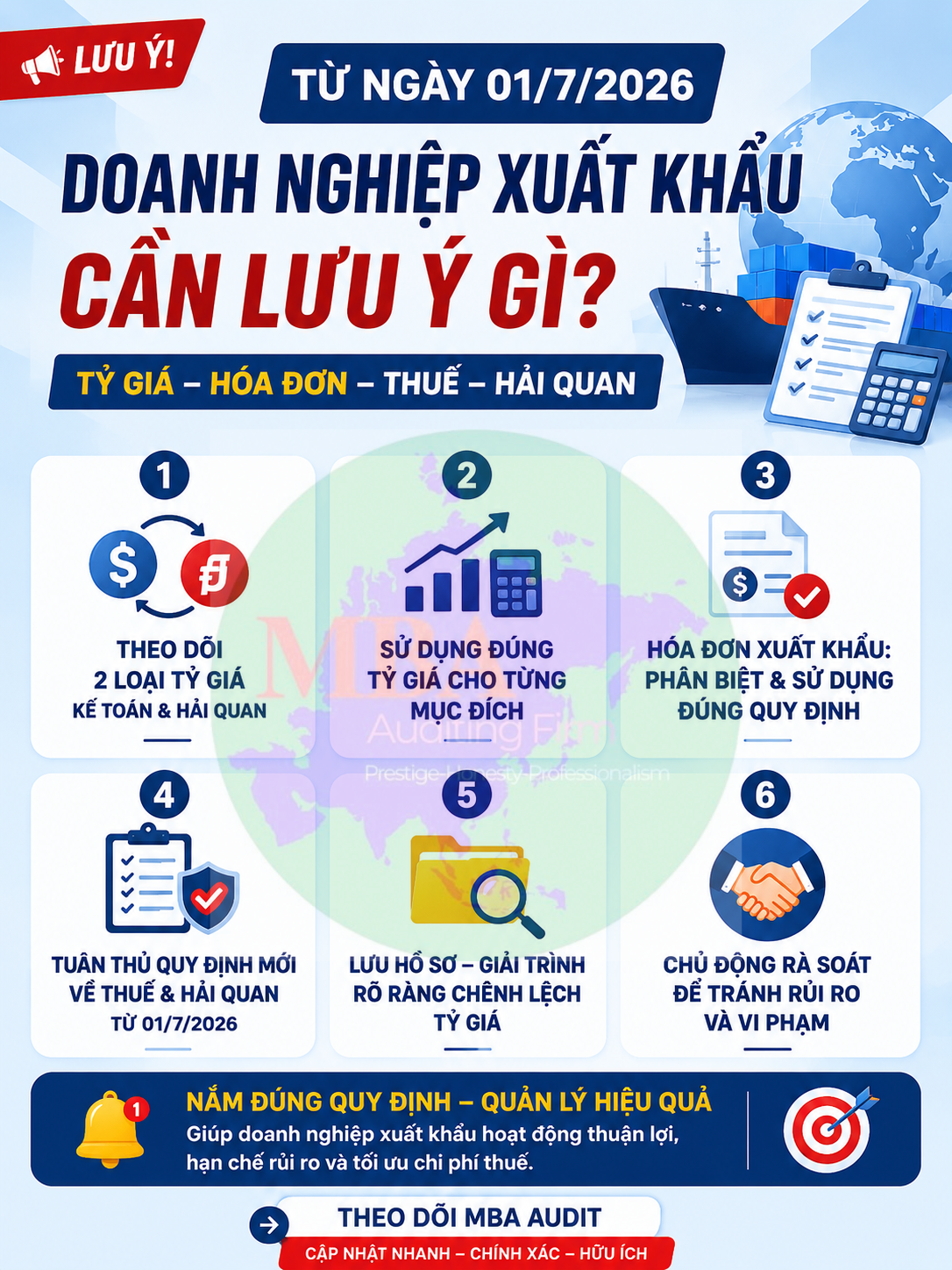
🚢 FROM 1 JULY 2026: WHAT SHOULD EXPORTING ENTERPRISES NOTE ABOUT EXCHANGE RATES AND INVOICES?
From 1 July 2026, several new regulations on tax administration, exchange rates and e-invoices will take effect.
For exporting enterprises, one important point to note is:
⚠️ A single export transaction may require different exchange rates for accounting purposes and for tax and
customs procedures.
If an enterprise applies the wrong exchange rate, figures in its accounting records , tax returns and
customs declarations may not match.
📌 1. Exporting enterprises may need to monitor two types
of exchange rates
This can be understood simply as follows:
- 📘 Accounting exchange rate: used for accounting record purposes.
- 🛃 Tax and customs exchange rate: used to determine amounts for tax declaration and customs procedures.
These two exchange rates may differ.
💡 Simple example:
An enterprise exports a shipment worth 10,000 USD.
When recording revenue in its accounting records, the enterprise applies the exchange rate required
under accounting regulations.
When registering the customs declaration, the enterprise applies the exchange rate prescribed under
customs regulations.
If the two exchange rates are different, the revenue converted into Vietnamese dong in the accounting
records and in the customs dossier may also differ.
✅ This is not necessarily incorrect, but the enterprise must determine the correct exchange rate for each purpose
and maintain clear supporting records explaining the difference.
📘 2. Exchange rate used for accounting purposes
The accounting exchange rate is used to:
- ✅ Record export revenue;
- ✅ Record outstanding amounts receivable from customers;
- ✅ Monitor foreign currency receivables;
- ✅ Calculate and record foreign exchange differences.
Under accounting regulations, enterprises use the actual transaction exchange rate at the time the transaction arises.
Enterprises may choose to use the average telegraphic transfer rate or an approximate exchange rate, provided that
the difference does not exceed the permitted limit compared with the average telegraphic transfer rate of
the commercial bank with which the enterprise regularly conducts transactions.
🔎 Simply put
The accounting exchange rate is usually obtained from the bank that the enterprise regularly uses to receive
or make payments.
Enterprises should apply a consistent exchange rate policy and should not arbitrarily change the method for
determining exchange rates between transactions.
🛃 3. Exchange rate used for customs declarations from 1 July 2026
Under the new regulations, the exchange rate used to determine the dutiable value for customs declarations is:
📌 The foreign currency buying rate via telegraphic transfer announced by Vietcombank’s Head Office at
the end of Thursday of the immediately preceding week.
This exchange rate is used for customs declarations registered in the following week.
If Thursday falls on a day off or public holiday, enterprises will use the end-of-day exchange rate of the immediately
preceding working day.
💡 Example
An enterprise registers customs declarations during the week from Monday to Sunday.
The enterprise will use the Vietcombank exchange rate determined at the end of Thursday of the preceding week.
Therefore, the customs exchange rate is generally kept stable for customs declarations registered within the same week.
For foreign currencies for which Vietcombank has not announced an exchange rate, the exchange rate may be
determined through cross exchange rates in accordance with regulations of the State Bank of Vietnam.
📌 Regulations on exchange rates for tax calculation and customs procedures are implemented in accordance
with Decree No. 252/2026/ND-CP, effective from 1 July, 2026.
🧾 4. Should the customs exchange rate be used when issuing
export invoices?
This is a point enterprises should be particularly cautious about.
Currently, the new regulations have clarified the exchange rate used for tax calculation and customs declarations.
However, enterprises should not automatically apply the customs exchange rate to all export invoices in every case.
Therefore, enterprises should clearly distinguish between:
- 📘 Exchange rates used for accounting purposes;
- 🛃 Exchange rates used for customs declaration purposes;
- 🧾 Exchange rates used on invoices and tax declaration dossiers;
- 📊 Exchange rates used to reconcile export revenue.
Until detailed guidance or a unified approach is issued by the competent authority, enterprises should:
- ✅ Avoid arbitrarily using a single exchange rate for all purposes;
- ✅ Check how exchange rates are set in invoicing software and accounting software;
- ✅ Retain the exchange rate tables used;
- ✅ Prepare reconciliation statements where discrepancies arise between accounting data, invoices
and customs documents; - ✅ Consult a professional adviser or the directly managing tax authority for high-value transactions.
📊 5. Comparison table:
Accounting exchange rate vs Customs exchange rate
| Item | 📘 Accounting exchange rate | 🛃 Tax and customs exchange rate |
|---|---|---|
| Purpose | Recording revenue, receivables and foreign exchange differences | Used for tax declaration and determining the dutiable value on customs declarations |
| Source of exchange rates | The commercial bank with which the enterprise regularly conducts transactions | Vietcombank Head Office |
| Time of determination | At the time of the transaction or according to the consistently applied accounting policy | At the end of Thursday of the immediately preceding week |
| Applicable Period | Based on the transaction date or the enterprise’s determined period | Applies to customs declarations registered in the following week |
| Could they be different? | Yes | Yes |
✅ Important conclusion
Enterprises should not automatically adjust two different figures simply to make them match.
The first step is to identify the purpose each figure serves and the regulation under which it is determined.
🧾 6. What types of invoices can exporting enterprises use?
From 1 July 2026, regulations on e-invoices and e-documents will be implemented under Decree No. 254/2026/NĐ-CP.
This Decree was issued on 30 June 2026 and takes effect from 1 July 2026.
Depending on the tax calculation method and the enterprise’s conditions, export activities may use one of
the following types of invoices and documents:
🧾 6.1. Electronic Value-Added Tax (VAT) invoice
Applicable to enterprises that declare VAT using the credit method.
This invoice may be used when:
- ✅ Exporting goods overseas;
- ✅ Providing services to foreign organisations or individuals;
- ✅ Selling goods into a non-tariff zone;
- ✅ Carrying out transactions treated as exports in accordance with regulations.
🧾 6.2. Electronic sales invoice
Applicable to organisations, business households and individual business operators that calculate VAT
using the direct method.
Electronic sales invoices may also be used for:
- ✅ Exporting goods;
- ✅ Providing services to foreign organisations or individuals;
- ✅ Selling goods into a non-tariff zone;
- ✅ Certain transactions between organisations and individuals within a non-tariff zone.
For invoices issued by organisations or individuals in a non-tariff zone, the invoice must contain the required
contents applicable to non-tariff zones.
💻 6.3. E-commercial invoice
Enterprises exporting goods or providing services overseas may use e-commercial invoices when they satisfy
the conditions for electronically transferring invoice data to the tax authority.
If the data transfer conditions are not satisfied, enterprises may choose to use:
- ✅ Electronic VAT invoice; or
- ✅ Electronic sales invoice.
Enterprises should check the connectivity of their e-invoicing software before choosing this type of invoice.
📦 6.4. Internal delivery-cum-transport note
An internal delivery-cum-transport note is used in certain cases where goods are released from the warehouse
for transportation but no sale has arisen at that time.
This document is registered, used and managed in accordance with regulations on invoices.
⚠️ An internal delivery-cum-transport note cannot always replace a sales invoice or export invoice.
Enterprises must determine the nature of each transaction correctly and issue the appropriate document.
⏰ 7. Timing of export invoice issuance
For exported goods, including goods processed for export, the seller may determine the timing for issuing:
- 🧾 E-commercial invoices;
- 🧾 Electronic VAT invoice;
- 🧾 Electronic sales invoice.
However, the invoice must be issued:
⚠️ No later than the next working day following the date on which the goods are cleared by customs.
💡 Example 1
The goods are cleared by customs on Monday.
The enterprise must issue the invoice no later than Tuesday, provided that Tuesday is a working day.
💡 Example 2
The goods are cleared by customs on Friday.
If Saturday and Sunday are non-working days, the next working day may be Monday. The enterprise should refer
to the applicable working schedule, public holidays and specific regulations to determine the invoice
issuance deadline.
💡 Example 3
The goods are cleared by customs before a public holiday.
The enterprise must determine the first working day after the holiday to calculate the final deadline for
issuing the invoice.
📌 Enterprises should not wait until payment is received from customers before issuing invoices, because the timing
of export invoice issuance is determined based on the customs clearance date of the goods and does not depend entirely
on the customer’s payment date.
✅ 8. What should businesses do immediately?
To minimise errors, exporting enterprises should take the following actions:
1️⃣ Review the accounting exchange rate policy
Clearly determine:
- Which bank’s exchange rate the enterprise is currently using;
- Whether the exchange rate is obtained on a daily, weekly or monthly basis;
- hether this method has been specified in the enterprise’s accounting policy;
- Whether all relevant departments are applying it consistently.
2️⃣ Update customs exchange rates on a weekly basis
Assign a responsible person to monitor and retain the Vietcombank exchange rate used for each week of customs declaration registration.
3️⃣ Check the invoicing software
Ensure that the software can:
- Issue the correct type of invoice;
- Record foreign currency and exchange rates;
- Transfer invoice data to the tax authority;
- Track customs clearance dates and alert users of invoice issuance deadlines.
4️⃣ Reconcile three data sources
Periodically reconcile:
- Accounting records;
- Export invoices;
- Custom declarations.
If discrepancies arise, the enterprise must identify the cause and retain supporting explanations.
5️⃣ Closely monitor customs clearance dates
Do not exceed the invoice issuance deadline, which is the next working day following the customs clearance date.
6️⃣ Issue internal guidance
The accounting, import/export and sales departments should agree on:
- Who obtains the exchange rate;
- Who issues the invoice;
- Who checks the customs clearance date;
- Who reconciles the data;
- How discrepancies between the accounting exchange rate and the customs exchange rate should be handled.
📝 9. MBA Audit’s note
The new regulations may result in differences between:
- 📘 Revenue recorded in the accounting records;
- 🧾 Converted value show on invoices;
- 🛃 Value declared on customs declarations;
- 📊 Revenue used for tax declaration purposes.
Enterprises should not review each document in isolation, but should reconcile the entire dossier for each export shipment.
Circular No.89/2026/TT-BTC takes effect from 1 July 2026 and replaces several previous tax administration regulations,
including Circular No.80/2021/TT-BTC and related amending and supplementing documents.
Regulations on e-invoices, invoice types and invoice issuance timing should continue to be monitored together with
Decree No. 254/2026/ND-CP and other relevant guidance documents.
🤝 MBA AUDIT IS READY TO SUPPORT ENTERPRISES
MBA Audit supports enterprises with:
- ✅ Reviewing the application of exchange rates to export activities;
- ✅ Reviewing invoices, customs declarations and accounting records;
- ✅ Reconciling export revenue across relevant departments;
- ✅ Checking the timing of invoice issuance;
- ✅ Developing procedures for controlling export documentation;
- ✅ Advising on how to handle discrepancies between accounting data and customs data.
📞 Contact MBA Audit for advice and dossier review tailored to your enterprise’s actual situation.
📌 Note
This content is prepared for general reference purposes only. Its application should be assessed based on the actual
records, type of export activity and specific circumstances of each enterprise.
- 🚨 OFFICIAL UPDATE – Effective from 01/01/2026: Personal Deductions Increase to VND 15.5 Million/Month
- 🚨 WHAT MICRO-ENTERPRISES NEED TO KNOW: DEFINITION CRITERIA & NEW ACCOUNTING RULES EFFECTIVE FROM JULY 1, 2026
- 📊 5 SIGNS OF AN ENTERPRISE THAT LOOKS STRONG ON THE OUTSIDE BUT IS WEAK INSIDE
- 🚨 HOT UPDATE – DECREE NO. 144/2026/NĐ-CP ON VAT
- ⚠️ FROM JULY 1, 2026: BUSINESSES WILL HAVE ONLY FIVE YEARS TO VOLUNTARILY FILE SUPPLEMENTARY TAX RETURNS