VAT REFUND TOPIC · GUIDANCE FOR ENTERPRISES
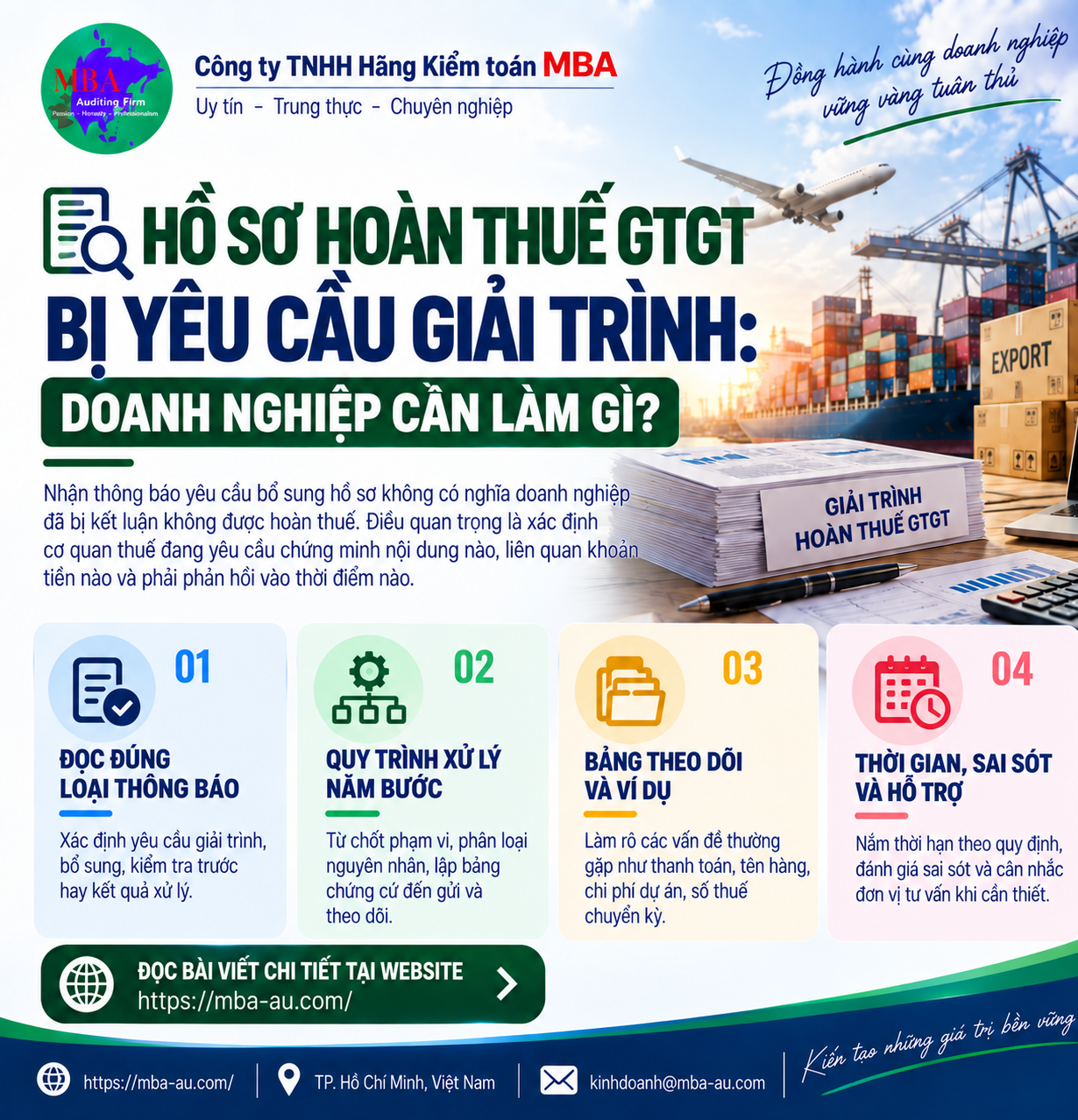
📌 VAT REFUND DOSSIER CLARIFICATION: WHAT TO DO
Receiving a notice requesting additional documents does not mean that the business has already been concluded
as ineligible for a tax refund.
The first step is to identify exactly what the tax authority is asking the business to prove, which amount is involved,
and when the response must be submitted.
An effective explanation should connect the request, the actual transaction, the applicable legal basis, and the
supporting documents.
Submitting a large number of documents without clearly indicating which issue each document addresses may make
the review process more difficult.
📌 1. Distinguish requests for supplementation from processing
results
| Dossier status | Immediate action required |
|---|---|
| 📄 Request for explanation and additional information. | Review each issue; record the date of issuance, response deadline, and documents to be provided. |
| 🔎 Notice of transfer of all or part of the dossier to pre-refund inspection. | Identify the inspection scope, the relevant amount, and prepare documents according to that scope. |
| ⚠️ Notice of amounts not yet eligible or not refundable. | Review the reasons and handling approach for each item; do not look only at the total amount. |
| ✅ Decision on refund or refund combined with offsetting. | Check the refund amount, offsetting amount, payment receipt details, and update the accounting records. |
📌 Note:
The table above is intended for internal task classification. Specific rights, obligations and processing steps must be
determined based on the content of the document received and the applicable regulations, rather than inferred
from abbreviated names used in emails.
⏱️ 2. Determine the response deadline immediately upon receipt
of the notice
For the case specified at Point b.1, Clause 1, Article 49 of Circular No. 89/2026/TT-BTC, the deadline for providing an
explanation is 10 working days from the date on which the tax authority issues the notice.
It should not be automatically counted from the date on which an employee opens the email. This is not a general
deadline applicable to all tax audit requests.
[1]
⚠️ The explanation deadline should not be automatically calculated from the date on which an employee opens the email.
The enterprise should forward the notice to the person in charge on the date of receipt and record it in the shared
schedule at the same time.
If the content is unclear or difficult to complete, the enterprise should proactively communicate in writing; it should not
assume that a request for an extension has been approved.
🔄 3. Five-step handling procedure
1️⃣ Step 1. Define the scope of each request
Break down the notice into specific work items. Each item should clearly state the tax period, transaction, amount, and
response required.
If the tax authority requests clarification of a payment, do not simply resend the invoice without explaining the payment
that was actually made.
2️⃣ Step 2. Classify the causes
-
Missing documents:
the documents exist but have not yet been compiled or submitted. -
Data discrepancies:
differences in item names, recognition dates, quantities, exchange rates or values across different sources. -
Eligibility issues:
the basis for deduction, tax rate, tax refund or project legal status needs to be assessed. -
Factual errors:
declarations, calculations or supporting documents need to be handled in accordance with regulations.
Each of the four groups requires a different handling approach. A blanket statement such as “the enterprise has complied
with regulations” should not be used to respond to every issue.
3️⃣ Step 3. Prepare an evidence schedule
Each argument should be linked to a document, with the document number, date and location clearly indicated.
Appendices and file names should be numbered and named consistently so that the reviewer can locate them immediately.
4️⃣ Step 4. Recalculate the impact on the tax amount
Distinguish between items with sufficient supporting basis, items requiring additional documents, items containing errors,
and items requiring expert opinion.
A change in a single input item may affect allocation, offsetting and carry-forward amounts; therefore, the entire related spreadsheet should be reviewed, not only one line.
5️⃣ Step 5. Submit, retain and monitor
Check the signatory, submission channel, reference notice number and list of attachments.
Retain proof of submission, the acknowledgment of receipt and the final version.
After submission, update the status of responded items, pending items and any new requests.
📊 4. What columns should the tracking table include?
| Issue | How to clarify | Suggested documents | Responsible person |
|---|---|---|---|
| 💵 Bank amount differs from invoice amount. | Separate advance payments, bank charges, discounts or multiple invoices paid together. | Contract, bank documents and payment allocation schedule. | Accounts receivable/payable accountant. |
| 📦 Item names differ between documents. | Clarify internal product codes, trade names, specifications and corresponding transactions. | Orders, delivery documents, customs dossiers and product code list. | Import-Export team. |
| 🏗️ Which project the costs relate to. | Determine the cost category, time of occurrence and purpose of use. | Contracts, acceptance records, cost schedules and project documents. | Project management team. |
| 🧾 Carried-forward tax amount does not match. | Trace back to the original return, supplementary return and amount previously requested for refund. | Tax movement schedule, acknowledgment of receipt and previous decisions. | Tax accountant. |
📌 The following columns should also be added: affected amount, deadline, reviewer and status.
This is a proposed management table, not a statutory form.
💵 5. Example: clarifying a payment discrepancy
Suppose the invoice value is USD 100,000, while the credit amount is USD 99,950.
The business receives a request to clarify the USD 50 discrepancy.
🧮 DISCREPANCY REQUIRING EXPLANATION
USD 100,000 − USD 99,950 =
USD 50
The appropriate approach is to review the contract to determine which party bears the bank charges, and to check
the remittance details, bank documents and accounting treatment.
If the documents confirm that the USD 50 difference is a bank charge, the explanation should clearly identify the
relevant documents and show how they link to the accounts receivable.
If there is no supporting evidence, the business should not simply assert that it is a bank charge or create documents to
make the figures match.
📌 Suggested response structure:
Issue requiring clarification
→ actual transaction
→ figures and reason for the discrepancy
→ applicable basis
→ supporting documents
→ request for consideration
This example only illustrates the presentation method and does not conclude whether any specific transaction qualifies
for a refund.
⏳ 6. How should the impact on the VAT refund timeline be explained?
Article 31 of Decree No. 252/2026/ND-CP provides that the processing time limit is 06 working days from the date of the
notice of receipt for cases subject to refund-before-inspection, and 10 working days from the date of the conclusion or
decision issued after on-site inspection for cases subject to inspection-before-refund.
The time taken by the enterprise to provide explanations or supplementary information upon request is not included in
the processing time limit.
[2]
⚠️ Do not use the 10-working-day timeframe to commit to the date on which the refund will be received after submission.
Therefore, the receipt date, supplementation period, review period and result issuance date should be tracked separately.
🔎 7. If errors are discovered during the explanation process
The business should not simply revise the explanation spreadsheet and ignore the previously submitted dossier.
It is necessary to determine which tax return is affected by the error, the current processing stage of the dossier, and the
adjustment procedures that may be applied.
Any supplementary declaration, amendment or cancellation of the dossier must be assessed based on the specific status
of the case; it should not be assumed that the dossier can always be withdrawn and resubmitted.
📌 Cases where only part of the refund amount is under clarification:
Figures with sufficient supporting basis should be separated from the portion currently under clarification.
The mechanism for handling these separate components is provided in Article 49 of Circular No. 89/2026/TT-BTC; this
does not mean that the enterprise may unilaterally decide which portion should be refunded immediately.
[1]
🤝 8. When should a consulting firm be engaged for support?
- 🔹 The issue involves accounting, customs, payment and project legal matters at the same time.
- 🔹 The dossier spans multiple periods or involves multiple adjustments.
- 🔹 It is necessary to distinguish between insufficient evidence and failure to meet conditions.
- 🔹 The enterprise does not yet have an independent reviewer for the spreadsheets and underlying rationale.
👉 The value of consulting lies in clarifying issues, assessing the basis, and organizing a verifiable dossier; it does not
mean guaranteeing a refund by any means necessary.
A cautious conclusion on items without sufficient basis can help businesses plan more realistically.
💬 Discuss your needs with MBA
MBA Auditing Firm Co., Ltd. assists in reviewing conditions, data and VAT refund documentation, and coordinates the
preparation of explanations within the agreed scope of work.
To discuss support, businesses may prepare the tax authority’s notice, previously submitted dossier, worksheet
showing the refund amount requested, and a description of the key issues.
Documents should only be shared through agreed channels that meet security requirements.
Please use the subject line “Support for VAT refund dossier clarification”.
🌐 Official contact information: mba-au.com.
The scope, timeline and service fees are determined following an initial assessment. The final outcome falls under the
authority of the tax authority.
- 📢TAX DEPARTMENT RESPONDS ON THE 0% VAT RATE FOR ON-THE-SPOT IMPORT/EXPORT GOODS
- 👉 VAT REFUND CONDITIONS FOR EXPORTS – DON’T GET IT WRONG!
- 💚 MBA AUDIT ACCOMPANIES THE TAX AUTHORITY IN SUPPORTING BUSINESSES NATIONWIDE
- 📢 DO HOUSEHOLD BUSINESSES WITH ANNUAL REVENUE UNDER 500 MILLION VND NEED TO STOP USING E-INVOICES?
- 🚨 WHAT MICRO-ENTERPRISES NEED TO KNOW: DEFINITION CRITERIA & NEW ACCOUNTING RULES EFFECTIVE FROM JULY 1, 2026