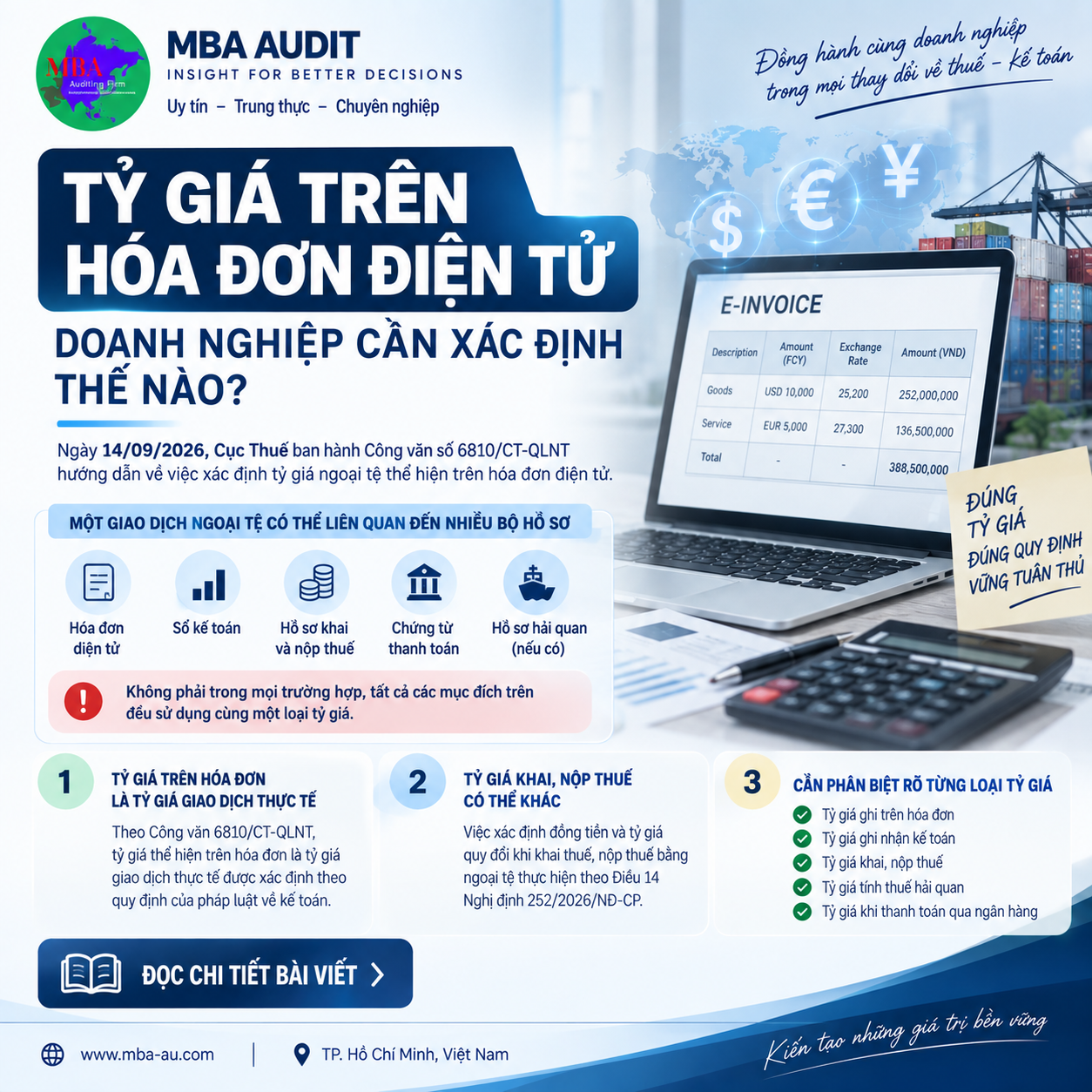
💱 EXCHANGE RATES ON E-INVOICES: HOW SHOULD BUSINESSES DETERMINE THEM?
A transaction denominated in USD, EUR or another foreign currency may involve several different sets of records
at the same time:
🧾 E-invoices
📊 Accounting records
💰 Tax declaration and payment records
🏦 Payment documents
🚢 Customs documents, if any
An important point to note is that the same exchange rate is not necessarily used for all of these purposes in every case.
On 14 September 2026, the Tax Department issued Official Letter No. 6810/CT-QLNT, providing guidance on determining
the foreign exchange rate to be shown on e-invoices.
🧾 1. When may an invoice be denominated in a foreign currency?
For economic and financial transactions arising in a foreign currency in accordance with foreign exchange regulations,
the seller shall present the monetary amounts on the invoice in accordance with the regulations on e-invoices.
At the same time, the invoice must show the applicable exchange rate between the foreign currency and Vietnamese
Dong in accordance with regulations.
📌 Therefore, when a transaction arises in a foreign currency, the enterprise should not only focus on the USD, EUR
or other foreign currency amount stated in the contract, but should also correctly determine the exchange rate to be
shown on the invoice.
📌 2. Which exchange rate should be shown on the invoice?
According to Official Letter No. 6810/CT-QLNT:
👉 The exchange rate shown on the invoice is the actual transaction exchange rate determined in accordance
with accounting regulations.
This is an important point because, in practice, enterprises may encounter several different exchange rate
concepts at the same time:
- 💱 Actual transaction exchange rate for accounting purposes;
- 🧾 Exchange rate used for invoicing;
- 💰 Exchange rate used for tax declaration and payment;
- 🚢 Exchange rate used for tax calculation on exported and imported goods;
- 🏦 Actual exchange rate applied when payment is made through a bank.
📌 These exchange rates should be determined according to their respective purposes and applicable legal bases.
📊 3. How is the “actual transaction exchange rate” determined
for accounting purposes?
Under the current enterprise accounting regulations, transactions denominated in foreign currencies must be
translated using an exchange rate appropriate to the nature and substance of the underlying economic transaction.
The actual transaction exchange rate on the transaction date may be determined based on:
- 🏦 The average telegraphic transfer buying and selling exchange rate quoted by the commercial bank with
which the enterprise regularly conducts transactions; or - 📌 An approximate exchange rate that satisfies the conditions prescribed under accounting regulations.
Therefore, enterprises should establish a consistent policy for determining exchange rates and retain supporting
evidence for the rate applied at the time the transaction arises.
💰 4. Must the exchange rate shown on the invoice always be the
same as the exchange rate used for tax declaration and payment?
It should not be assumed that they are always the same.
Official Letter No. 6810/CT-QLNT distinguishes between the following:
✅ Exchange rate shown on the invoice
The actual transaction exchange rate determined in accordance with accounting regulations shall apply.
✅ Amounts declared and paid in foreign currency for tax purposes
The currency used for tax declaration and payment, as well as the applicable conversion exchange rate, shall be
determined in accordance with Article 14 of Decree No. 252/2026/ND-CP.
📌 Therefore, enterprises should determine the appropriate exchange rate based on its specific purpose rather
than applying a single exchange rate to all documents and records.
🚢 5. What if the enterprise is engaged in import-export activities?
For exported and imported goods, the exchange rate used for tax calculation shall be determined in accordance
with customs regulations.
Therefore, an import-export transaction may involve several exchange rates at the same time:
- 🧾 Exchange rate shown on the invoice;
- 📊 Exchange rate used for accounting purposes;
- 🚢 Customs exchange rate used for tax calculation;
- 🏦 Actual payment exchange rate.
Enterprises should clearly distinguish the purpose of each exchange rate to avoid incorrect reconciliation between
different sets of records.
🔎 6. Why can discrepancies arise?
A foreign currency transaction may go through several stages:
Contract → delivery of goods/provision of services → invoicing → accounting recognition → tax declaration
→ payment → receivables/payables reconciliation
If different departments use exchange rates differently without a consistent policy, discrepancies may arise between:
- 🧾 E-invoices;
- 📊 Revenue and receivables/payables recorded in the accounting books;
- 💰 Tax records;
- 🏦 Bank statements and payment documents;
- 🚢 Customs declarations.
⚠️ A discrepancy does not necessarily mean that an error or violation has occurred. However, the enterprise should
be able to explain the reason for the difference and the basis used to determine the applicable exchange rate.
⚠️ 7. Common mistakes
Enterprises should pay attention to the following:
- ❌ Automatically using the tax calculation exchange rate or customs exchange rate on the invoice;
- ❌ Failing to determine or retain supporting evidence for the actual transaction exchange rate;
- ❌ Using an exchange rate that is inconsistent with the accounting policy adopted by the enterprise;
- ❌ Failing to distinguish between the accounting exchange rate and the exchange rate used for tax purposes;
- ❌ Failing to reconcile invoices with accounting records, contracts and payment documents;
- ❌ Recording exchange rate differences without correctly identifying the nature of the underlying transaction.
✅ 8. How should enterprises manage foreign currency transactions?
For transactions denominated in foreign currencies, enterprises should follow these steps:
1️⃣ Identify the nature of the transaction
Is it a sale of goods, provision of services, export, import, advance payment or settlement of receivables/payables?
2️⃣ Determine the exchange rate used for invoicing
Apply the actual transaction exchange rate in accordance with accounting regulations.
3️⃣ Separately determine the exchange rate used for tax purposes
Do not assume that the exchange rate shown on the invoice is also the exchange rate used for all tax purposes.
4️⃣ Check the applicable customs exchange rate requirements
This is particularly important for import and export activities.
5️⃣ Retain supporting evidence for the exchange rate applied
This may include:
- 📄 Contracts;
- 🧾 Invoices;
- 🏦 Bank documents;
- 💱 Exchange rate information from the selected bank;
- 📘 The enterprise’s accounting policies;
- 📂 Documents relating to the time the transaction arises.
6️⃣ Perform periodic reconciliations
Reconcile invoices, accounting records, tax records, bank payment documents and customs records, if applicable.
💡 KEY POINT TO REMEMBER
The exchange rate shown on an invoice is not simply a rate selected by the enterprise for foreign currency conversion.
According to the latest guidance from the Tax Department, for economic and financial transactions arising in foreign
currencies:
👉 The exchange rate shown on the invoice is the actual transaction exchange rate determined in accordance with
accounting regulations.
Meanwhile, exchange rates used for tax declaration, tax payment or tax calculation for imported and exported goods
should be determined in accordance with the relevant regulations applicable to each purpose.
Correctly distinguishing between these exchange rates helps enterprises maintain consistency across:
🧾 Invoices – 📊 Accounting – 💰 Tax – 🏦 Payments – 🚢 Customs
This makes it easier for enterprises to reconcile records and explain discrepancies when necessary.
📞 Does your enterprise issue invoices in foreign currencies?
Contact MBA Audit for support in reviewing your transactions and advising on an appropriate approach.
📌 Reference basis
This article has been prepared based on:
- Official Letter No. 6810/CT-QLNT dated 14 September 2026 issued by the Tax Department;
- Decree No. 254/2026/ND-CP;
- Decree No. 252/2026/ND-CP;
- Relevant accounting regulations.
This article is intended for general updates and reference purposes. The exchange rate applicable to each transaction
should be determined based on the nature of the transaction, the time it arises and the enterprise’s actual supporting
documents.
#MBAAudit #TyGia #HoaDonDienTu #NgoaiTe #KeToan #Thue #XuatNhapKhau #QuanLyThue
- 📢 DO HOUSEHOLD BUSINESSES WITH ANNUAL REVENUE UNDER 500 MILLION VND NEED TO STOP USING E-INVOICES?
- 📊 THE MARKET IS GETTING TOUGHER — OR IS THE GAME JUST CHANGING?
- GUIDANCE ON PERSONAL INCOME TAX (PIT) FOR GIFTS TO EMPLOYEES & COLLABORATORS
- 📢CORPORATE INCOME TAX 2025 – A NEW DECREE HAS BEEN ISSUED
- 🎉🧧 TET HOLIDAY ANNOUNCEMENT 🧧🎉