🚨 E-INVOICES: IS STORING ONLY THE PDF FILE LEGALLY SUFFICIENT?
📌 Enterprises should pay particular attention to the XML file of an e-invoice.
When receiving, sending and storing e-invoices, many enterprises often only download or save the PDF file
because it is easy to view, print and send by email.
However, according to the guidance of the General Department of Taxation in Official Letter No. 1152/TCT-CS
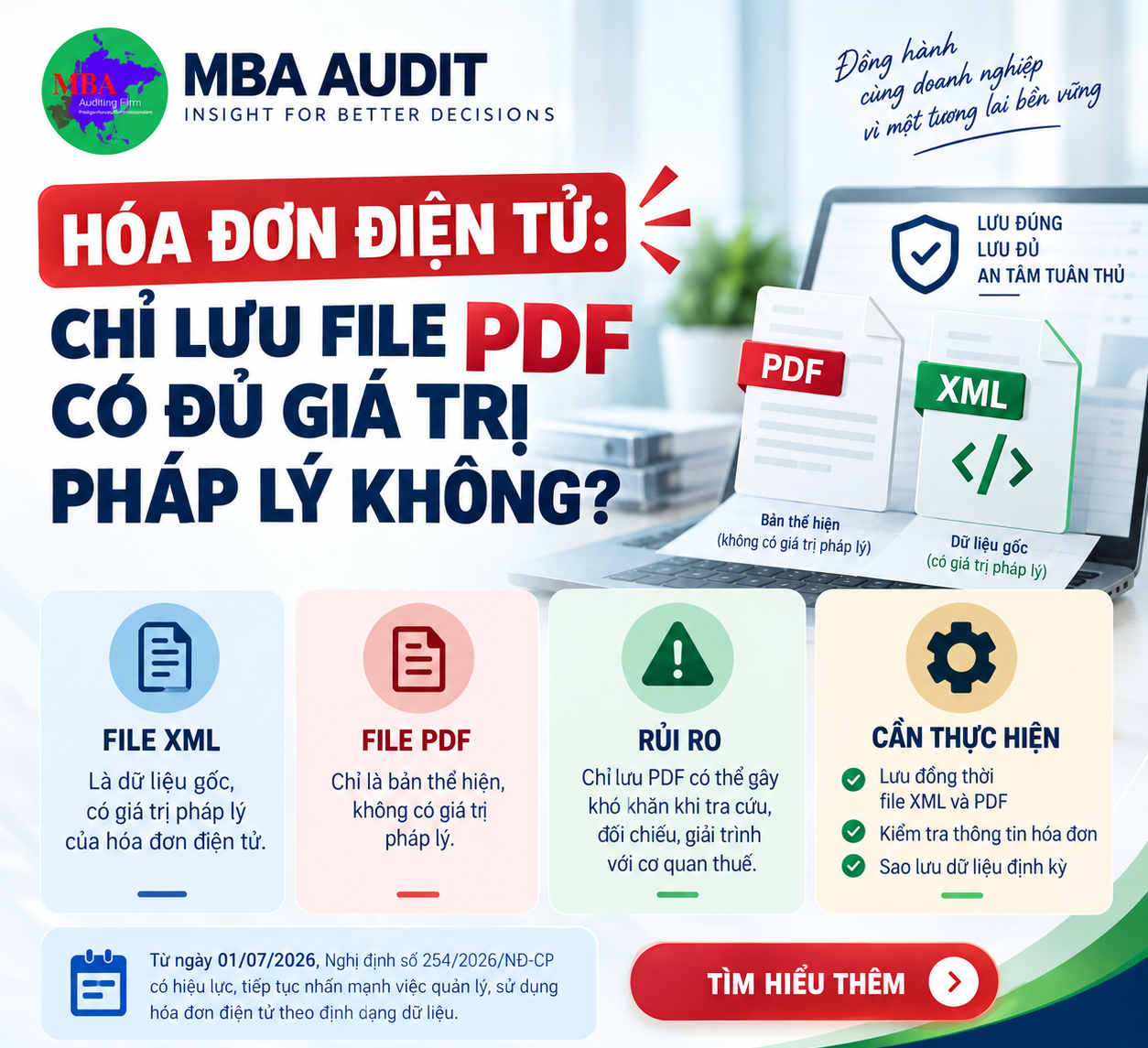
dated 5 April 2023, the XML file of an e-invoice is the file that has legal validity. The PDF file is only a representation
of the e-invoice and does not have legal validity.
⚠️ In other words, if an enterprise only stores the PDF file without retaining the XML file, it may face risks when
it needs to look up, reconcile, explain or provide the e-invoice to the tax authority.
🧾 1. How are XML files and PDF files different?
📂 XML file
The XML file is the original data file of an e-invoice.
This file contains the invoice’s business information in an electronic data format, serving the transmission,
receipt, lookup, verification and management of e-invoices.
👉 This is the file that has legal validity for the e-invoice.
📄 PDF file
The PDF file is the representation of the e-invoice.
Enterprises commonly use PDF files to:
- 👀 Quickly view invoice contents;
- 🖨️ Print invoices when needed for internal recordkeeping;
- 📧 Send invoices to customers or partners for convenient review;
- 📎 Attach invoices to payment dossiers.
📌 However, the PDF file is only a readable display version. It is not the original data file of the e-invoice.
⚠️ 2. Why should enterprises not store only PDF files?
Storing only PDF files may expose enterprises to risks in the following situations:
- ❌ The original data file is unavailable when requested by the tax authority;
- ❌ It may be difficult to verify the validity of e-invoices;
- ❌ It may be difficult to reconcile discrepancies between invoice data and the visual representation;
- ❌ There may be a risk of data loss in invoicing systems, email systems or accounting software;
- ❌ It may be difficult to prove the validity of invoices during tax finalization, tax inspection or tax audit.
Therefore, enterprises should store both XML and PDF files, with the XML file treated as important data that
must be carefully preserved.
🔎 3. What should enterprises check when receiving e-invoices?
When receiving e-invoices from suppliers, accountants should not only check the PDF file, but should also
review important information such as:
- ✅ Whether the XML file is fully available;
- ✅ The tax identification number, name and address of the seller and the buyer;
- ✅ Invoice number, invoice symbol and invoice issuance date;
- ✅ Name of goods or services;
- ✅ Value before tax, VAT rate and VAT amount;
- ✅ Total payment amount;
- ✅ Invoice status on the tax authority’s lookup system;
- ✅ Whether the invoice has been adjusted, replaced or cancelled.
⚠️ In particular, if there is any discrepancy between the XML file and the PDF file, the enterprise should
check again with the seller or look up the invoice data on the system to determine the correct information.
💻 4. Current regulations on e-invoices continue to emphasise
the data aspect
From 1 July 2026, Decree No. 254/2026/ND-CP takes effect, providing detailed regulations on e-invoices
and e-documents under Law on Tax Administration No. 108/2025/QH15.
This Decree continues to emphasise the principles of creating, managing and using e-invoices in data format,
and requires invoices to fully and accurately reflect the contents of economic transactions arising.
📌 This shows that e-invoice management is increasingly moving towards original data, transmission, lookup
and reconciliation capabilities on the system.
Therefore, enterprises need to shift from the mindset of “keeping printed copies” to the mindset of managing
e-invoice data.
📌 5. How should enterprises store e-invoices?
To mitigate risks, enterprises should establish an e-invoice storage process as follows:
1️⃣ Store both XML and PDF files
Do not store only the PDF file. Each e-invoice should include:
- 📂 XML file;
- 📄 PDF file;
- 📎 Related supporting documents, if any.
2️⃣ Arrange by period, supplier and expense type
Enterprises may classify invoices by:
- 📅 Month/quarter/year;
- 🏢 Supplier;
- 🧾 Expense type;
- 📁 Project/department;
- 📌 Invoice status: original, adjusted, replaced or cancelled.
3️⃣ Reconcile with accounting records and tax returns
E-invoices should be reconciled with:
- Accounting records;
- VAT returns;
- Payment dossiers;
- Contracts, acceptance records and goods receipt notes, if any.
4️⃣ Back up data periodically
Enterprises should implement a multi-layer backup strategy for e-invoice data, such as:
- Internal servers;
- Accounting software;
- Electronic storage platforms;
- Backup storage drives;
- Clearly defined access permissions.
🚫 6. Common mistakes
In practice, many enterprises still make the following mistakes:
- ❌ Storing only PDF files and not retaining XML files;
- ❌ Receiving invoices by email but failing to download and store the XML files;
- ❌ Failing to check invoice status on the system;
- ❌ Failing to distinguish between original invoices, adjusted invoices and replacement invoices;
- ❌ Storing invoices in a scattered manner, not by tax declaration period;
- ❌ Losing invoice data when accounting personnel leave;
- ❌ Having no process to verify input invoices before tax declaration.
These mistakes may cause difficulties for enterprises during tax finalization or when they need to explain
expenses and input VAT.
✅ 7. What should enterprises do now?
Enterprises should proactively review their e-invoice processes, particularly by:
- 🔎 Verifying whether all XML files are being properly retained;
- 📂 Reviewing the e-invoice data repository for previous years;
- 🧾 Reconciling input invoices with tax returns and accounting records;
- 📌 Assigning clear responsibility for invoice storage;
- 💻 Establishing procedures for downloading, verifying, storing and backing up invoices;
- ⚠️ Reviewing invoices that are available only in PDF format and determining how to supplement the data,
if necessary.
💡 Practical perspective from MBA Audit
An e-invoice is not merely a file to be printed or sent to customers.
It is important legal data and tax data of the enterprise.
As the tax authority increasingly strengthens management through electronic data, enterprises need to ensure
that invoices are stored in the correct format, are complete and can be retrieved when needed.
A visually clear PDF invoice is not enough. What matters is that the enterprise has a valid XML file, accurate data
and complete supporting documents.
🤝 How can MBA Audit support enterprises?
MBA Audit supports enterprises with:
- 📌 Reviewing input and output e-invoice dossiers;
- 📌 Checking the storage of XML and PDF files;
- 📌 Reconciling invoices with accounting records and tax returns;
- 📌 Reviewing risks relating to incorrect, cancelled, adjusted and replacement invoices;
- 📌 Advising on e-invoice storage and control processes;
- 📌 Assisting with explanations of invoice dossiers during tax inspections.
📞 Does your enterprise need to review its e-invoice data?
Contact MBA Audit for support in checking your dossiers and advising on the most appropriate solution.
📌 Note
This article has been prepared based on Official Letter No. 1152/TCT-CS dated 5 April 2023 issued by the General
Department of Taxation and relevant regulations on e-invoices and e-documents. From 1 July 2026, enterprises
should continue to update and apply Decree No. 254/2026/ND-CP and relevant guiding documents.
The application to each specific case should be determined based on actual dossiers and the legal regulations in
force at the relevant time.
#MBAAudit #HoaDonDienTu #FileXML #FilePDF #QuanLyHoaDon #KeToanThue #RuiRoThue #ChinhSachThue
#DoanhNghiep #TaxCompliance
- 📌 6 COMMON MISUNDERSTANDINGS AMONG ENTERPRISES REGARDING MANDATORY SOCIAL INSURANCE OBLIGATIONS
- ⏰ Overtime from 200-300 hours/year – What should businesses pay attention to?
- NEW REGULATIONS ON ACCOUNTING, TAXES, AND SOCIAL INSURANCE EFFECTIVE FROM JANUARY 1, 2026
- 🚨 ARE ENTERPRISES EXPOSED TO POTENTIAL RISKS FROM MANAGING MULTIPLE ACCOUNTING DATA SYSTEMS?
- 📢 OFFICIAL: EXTENSION OF TAX PAYMENT DEADLINES IN 2026 UNDER DECREE NO.245/2026/NĐ-CP