🧾 NIGHT-TIME TRANSACTIONS: MUST AN INVOICE BE ISSUED IMMEDIATELY DURING THE NIGHT?
This is a practical issue faced by many enterprises operating outside normal business hours, particularly in sectors
such as retail, transportation, services, food and beverage, e-commerce, and other business models involving
continuous transactions.
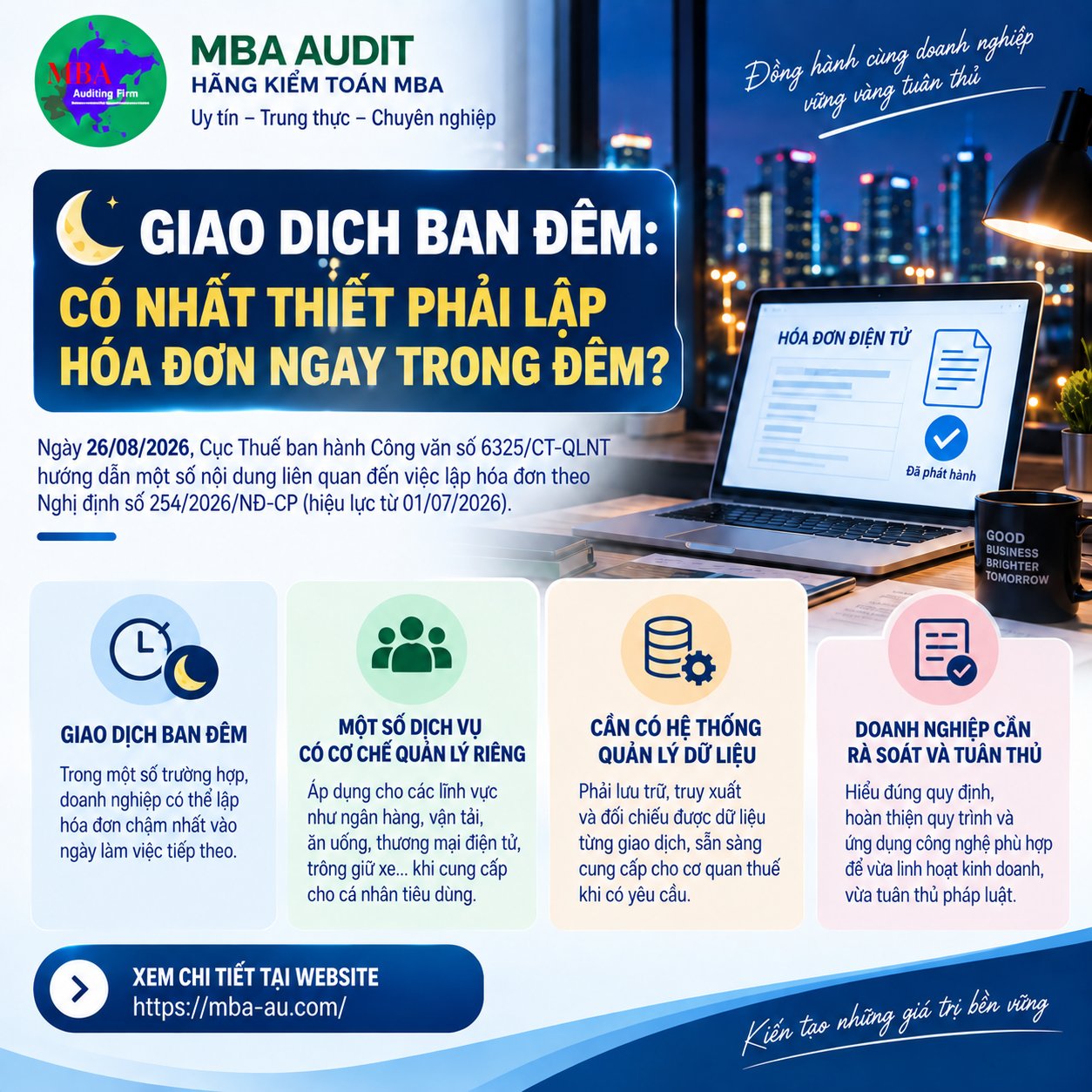
On 26 August 2026, the Tax Department issued Official Letter No. 6325/CT-QLNT, providing guidance on certain
matters relating to invoice issuance under Decree No. 254/2026/ND-CP, which took effect on 1 July 2026.
📌 There are two key points that enterprises should pay particular attention to.
🌙 1. Transactions arising during night-time working hours
Under Clause 5, Article 9 of Decree No. 254/2026/ND-CP:
When the seller:
- ❌ Does not have automated invoicing software; and
- 🌙 Has transactions involving the sale of goods or provision of services during night-time working hours as
prescribed by the Labour Code.
👉 The invoice must be issued no later than the next working day.
This is an important point for enterprises that conduct business during night-time hours but whose systems are
not yet able to automatically issue invoices at the time the transaction arises.
📌 Example
A sale transaction arises during night-time working hours, and the enterprise does not have an automated
invoicing system.
If the transaction satisfies the prescribed conditions, the enterprise may issue the invoice no later than the next
working day, rather than having to process it immediately during the night.
⚠️ However, this provision should not be interpreted as allowing enterprises to delay invoice issuance at their
own discretion.
The key conditions are:
- ✅ The transaction actually arises during night-time working hours;
- ✅ The seller does not have automated invoicing software;
- ✅ The invoice must be issued no later than the next working day.
👤 2. Certain services provided directly to individual consumers
are subject to specific management requirements
Point r, Clause 4, Article 9 of Decree No. 254/2026/ND-CP provides specific rules for certain enterprises providing
services directly to individual consumers.
The sectors referred to include:
🏦 Banking;
💳 Payment intermediary services;
📊 Credit information services;
📈 Securities;
🪙 Crypto-asset transactions;
🌱 Services related to carbon exchanges;
🛡️ Insurance;
📱 Money transfers via e-wallets;
⚡ Electricity disconnection and reconnection services;
🛒 E-commerce;
📦 Postal and direct delivery services supporting e-commerce;
🚌 Public passenger transport;
🚕 Taxis, contract vehicles and two-wheeled motorcycles;
🅿️ Vehicle parking services;
🎬 Cinema services;
📌 Other services that satisfy the prescribed conditions.
💻 3. Key requirement: a system capable of managing each
transaction in detail must be in place
For the above services, enterprises should satisfy system-related requirements such as:
- ✅ Having software that manages each transaction in detail;
- ✅ Storing payment collection data on a transaction-by-transaction basis;
- ✅ Ensuring that transaction data can be retrieved and reconciled;
- ✅ Being able to provide relevant data and supporting documents when requested by the tax authority or
other competent state authorities.
📌 Detailed transaction data is transmitted to the tax authority in accordance with the regulations on invoice data.
The seller is responsible for the accuracy of transaction information and the complete retention of relevant data.
🔎 4. The key change lies in how transaction data is managed
This regulation shows that invoice management is gradually shifting from merely checking individual invoices to
ensuring the ability to trace the full data flow:
Transaction → Payment data → Invoice → Reported revenue
For sectors with a high volume of daily transactions, an enterprise’s data system becomes an important part of
demonstrating the completeness and accuracy of reported revenue.
⚠️ 5. Not all night-time transactions may be invoiced on the
following day
The provision under Clause 5, Article 9 applies only when both of the following conditions are met:
🌙 The transaction arises during night-time working hours + the seller does not have automated invoicing software.
If the enterprise already has an automated invoicing system or is subject to specific rules on the timing of invoice
issuance, it must follow the mechanism applicable to that particular case.
Therefore, enterprises should avoid applying the “next working day” rule to all transactions arising outside normal
business hours.
✅ 6. What should enterprises review?
Enterprises that frequently have transactions arising outside normal business hours or during the night should review:
- 🔹 Whether the enterprise falls within the scope of Clause 5, Article 9;
- 🔹 Whether the current system is capable of automatically issuing invoices at the time the transaction arises;
- 🔹 Whether the transaction time and invoice issuance time are fully recorded and traceable;
- 🔹 Whether sales, payment and invoice data can be reconciled with one another;
- 🔹 Whether the invoicing process for night shifts and the following working day has been clearly defined.
💡 KEY POINTS TO REMEMBER
From 1 July 2026, the regulations on the timing of invoice issuance include a mechanism that is more suitable for
business models involving continuous transactions.
🌙 No automated invoicing software + transaction arising during night-time working hours
➡️ The invoice must be issued no later than the next working day.
💻 Certain services provided directly to individual consumers have transaction-level management systems
➡️ Detailed transaction data must be stored, retrievable and transmitted to the tax authority in accordance with
regulations.
📌 The key issue is not only “when the invoice is issued”, but also whether the enterprise can fully demonstrate
the data chain from the time the transaction arises through to reported revenue and the invoice issued.
📌 Reference basis
Official Letter No. 6325/CT-QLNT dated 26 August 2026 issued by the Tax Department; Point r, Clause 4 and Clause 5,
Article 9 of Decree No. 254/2026/ND-CP.
This article is intended for general updates and reference purposes. The application should be determined based
on each enterprise’s business model, invoicing system and the actual nature of its transactions.
#MBAAudit #HoaDonDienTu #NghiDinh254 #ThoiDiemLapHoaDon #KeToan #Thue #ThuongMaiDienTu #QuanLyDoanhThu
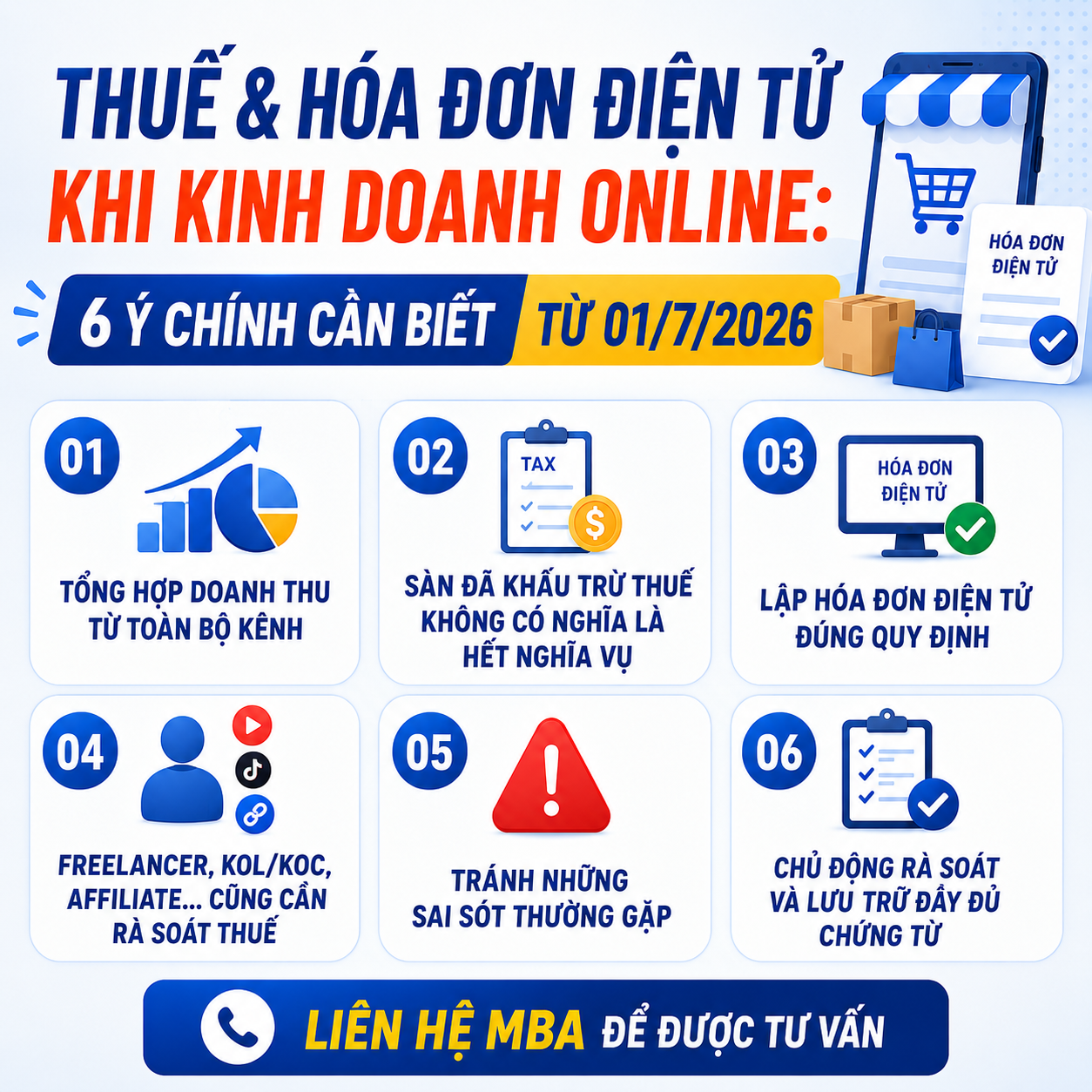
- 🛒 TAX AND E-INVOICES FOR ONLINE BUSINESS ACTIVITIES: KEY POINTS TO NOTE FROM 1 JULY 2026
- 🚨 HOT UPDATE – DECREE NO. 144/2026/NĐ-CP ON VAT
- Tax Obligations for Individuals – Household Businesses – Small Enterprises
- 📢CORPORATE INCOME TAX 2025 – A NEW DECREE HAS BEEN ISSUED
- 📢 Dependent Accounting Representative Office – How to Declare Taxes Correctly?